Soluble Humic Acid vs. Fulvic Acid: How to Choose the Right One for Your Crops?
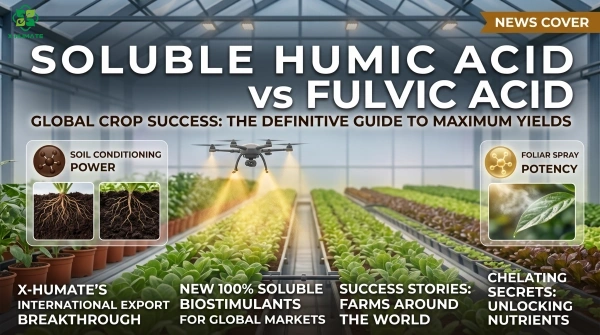
Soluble Humic Acid vs. Fulvic Acid: How to Choose the Right One for Your Crops?
For agricultural distributors and growers looking to boost crop yields, choosing between Soluble Humic Acid and Fulvic Acid can be confusing. While both are powerful organic biostimulants derived from natural leonardite, they serve different primary roles.
To save your valuable time and help you make the quickest, most profitable purchasing decision, we have broken down their key differences, focusing heavily on how to use them correctly.

Solubility and Application Comparison of Humic Substances
Direct Comparison Table: Humic Acid vs. Fulvic Acid
| Features | Soluble Humic Acid (e.g., Potassium Humate) | Fulvic Acid (Fulvic Acid Powder) |
|---|---|---|
| Molecular Weight | High molecular weight (large molecules) | Low molecular weight (small, highly active molecules) |
| Best Used For | Soil Application & Conditioning (long-term soil health) | Foliar Spray & Fast Absorption (immediate crop response) |
| pH Stability | Soluble in alkaline to neutral water (precipitates in acidic environments) | 100% soluble in all pH conditions (acid & hard water resistant) |
| Primary Benefit | Enhances soil structure, water retention, and root development | Chelates micronutrients, boosts cell permeability, improves stress resistance |
| X-Humate Product | X-Humate Potassium Humate Super | X-Humate Fulvic Acid 90% |
How to Apply Them Correctly (Application Guide)
The biggest difference between these two biostimulants lies in how and when you apply them to the crops.
1. When to Use Soluble Humic Acid (Focus on Soil)
Soluble Humic Acid (such as Potassium Humate) acts as a long-term soil builder. Because of its large molecular size, it stays in the soil longer to improve soil structure, increase Cation Exchange Capacity (CEC), and unlock bound nutrients like phosphorus.
- Best Application Method: Soil drenching, fertigation (drip irrigation), or base fertilizer blending.
- When to apply: Apply to the soil during land preparation, pre-planting, or early root growth stages to build a strong foundation.
2. When to Use Fulvic Acid (Focus on Plant)
Fulvic Acid is a fast-acting "transporter." Its small molecular size allows it to easily penetrate plant cell walls, carrying micronutrients directly into the plant tissues. It is also highly compatible with acidic liquid fertilizers and hard water.
- Best Application Method: Foliar spraying or seed soaking.
- When to apply: Spray during critical growth periods—such as flowering, fruit setting, or when crops are suffering from environmental stress (drought, cold, or transplant shock)—for immediate recovery.
💡 Pro Tip for Maximum ROI:
Don't choose just one. For the ultimate crop boost, apply X-Humate Potassium Humate to the soil to build a healthy root environment, and follow up with X-Humate Fulvic Acid as a foliar spray to feed the leaves directly.
As a leading organic fertilizer manufacturer with over 20 years of export experience, X-Humate (Tianjin Humate International Limited) provides 100% water-soluble, high-purity humic and fulvic series products registered with EU REACH, OMRI, and CERES.
Save your sourcing time and get premium quality directly from the factory. Visit www.x-humate.com to get a fast quote and request free samples today!
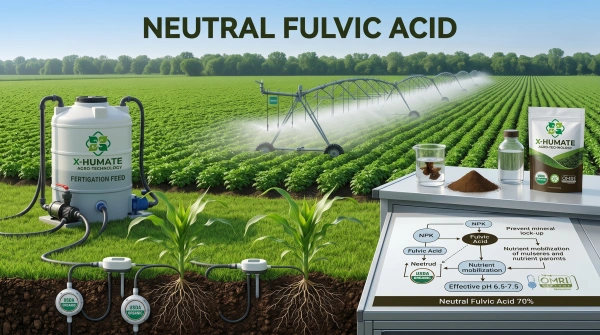
X-Humate Netural Fulvic Acid 70%
Synergy in the Soil: How to Combine EDTA/EDDHA Chelates with Humic and Fulvic Acids for Maximum Crop Uptake
Related Article


Source: Factory Direct Supply
Application: Selective flotation depressant for silicate gangues & sulfide ores.Eco-Profile: Non-toxic, biodegradable, and cost-effective.
Technical Highlights:
Humic Acid: 60% – 70%
Solubility: 95% – 99%
Moisture: 15%